
Appian is a business process automation tool that companies can use to automate complex business processes. It orchestrates processes across people, systems, and AI agents in a single platform.
According to TheirStack, more than 4,000 companies use Appian to build custom applications and workflows, including EY, Infosys, Capgemini, KPMG, and TCS. Therefore, candidates with Appian expertise can secure rewarding jobs across various industries.
MindMajix offers Advanced Appian Interview Questions 2026 to help you crack interviews and secure your dream career as an Appian Developer.
Table of Contents
- Skills Required for an Appian Developer
- Job Responsibilities of Appian Developers
- Appian BPM Interview Questions and Answers
- Appian Scenario-based Questions
- Frequently asked Questions
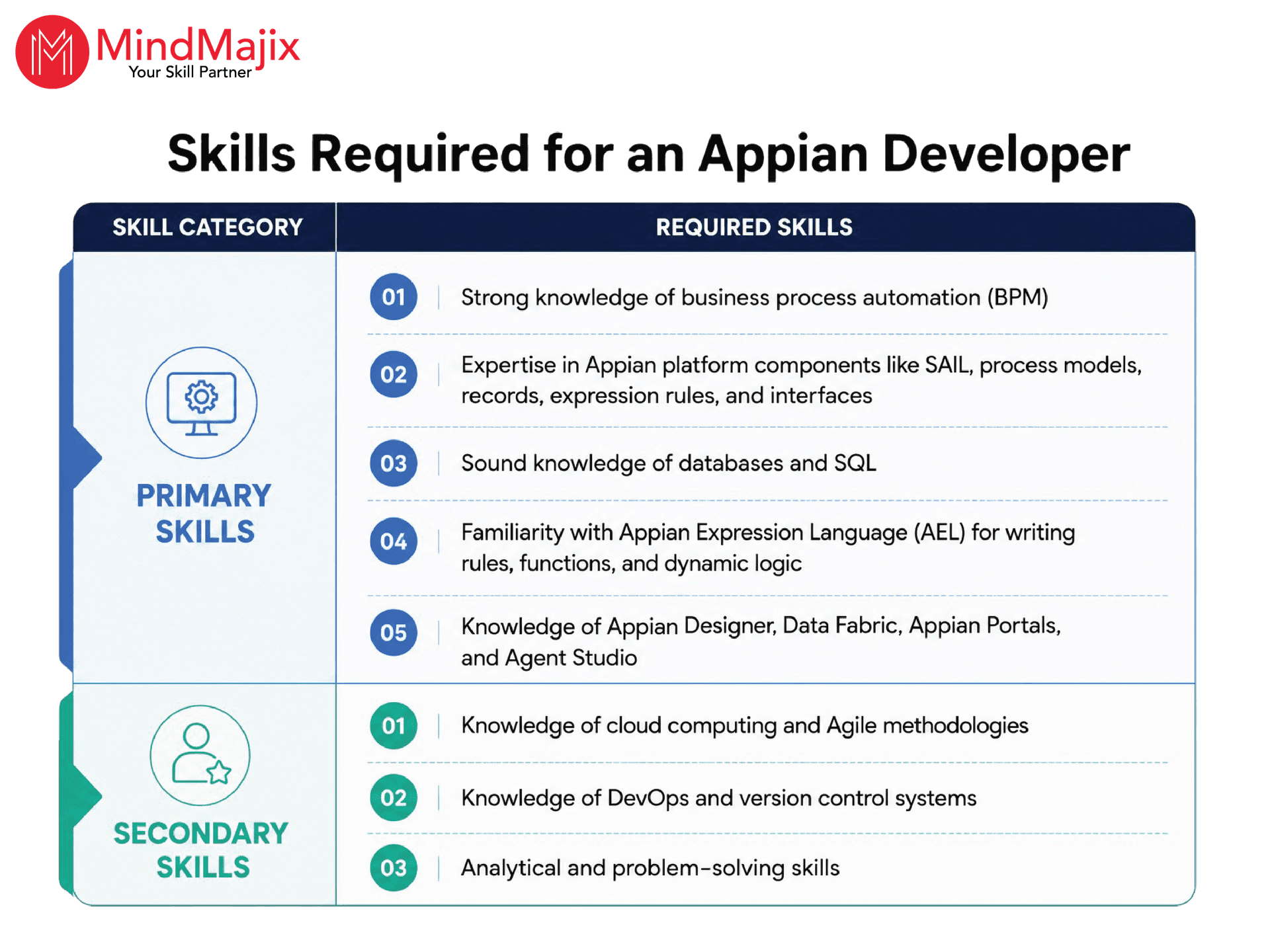
Skills Required for an Appian Developer
We’ll learn the essential skills required for Appian developers before preparing for Appian interviews.
Job Responsibilities of Appian Developers
Understanding the job responsibilities of Appian developers beforehand will help you prepare effectively for Appian interviews.
- Designing efficient enterprise applications and automating business processes
- Integrating applications with external systems
- Troubleshooting process failures, debugging expressions, and improving the user experience
- Designing and configuring sites or user-facing portals
- Building end-to-end applications using Appian Designer
- Designing process flows using the drag-and-drop process modeler
- Working with relational databases
- Building responsive UIs using SAIL
| If you want to enrich your career and become a professional in Appian, then visit Mindmajix - a global online training platform: "Appian Training" This course will help you to achieve excellence in this domain. |
Appian BPM Interview Question and Answers
1: What is Appian?
Appian is a leading BPM platform. It is well-known for its flexibility, delivering comprehensive BPM innovation and easy-to-use solutions tailored to the needs of governments worldwide and businesses. The Appian Enterprise BPM Suite is a 100% web-based solution with real-time analytics and integrated knowledge.
Appian enables collaboration between IT teams and business users, enabling customers to contribute to achieving corporate goals. Appian Everywhere is the first and only complete BPM Suite available on demand, offering the full functionality and power of Appian Enterprise through the Software-as-a-Service (SaaS) model.
2: What do you understand by BPM?
Business Process Management (BPM) is a field in operations management that focuses on improving corporate performance by managing and optimizing a company’s business processes. It can therefore be described as a “process optimization process.”
3: What is BPM Software?
It is a technology that automates, executes, and monitors business processes end-to-end by connecting people, applications, and systems.
4: What do you understand by Association?
An association is used to show relationships among data, text, other artifacts, and flow objects in a process. An association is represented in a Business Process Model by a dotted line with a lined arrowhead.
5: What do you understand by Business Process Diagram(BPD)?
A Business Process Diagram is a simple diagram composed of graphical elements that depicts a business process.
There are four primary elements in a BPD: flow objects, connecting objects, swimlanes, and artifacts.
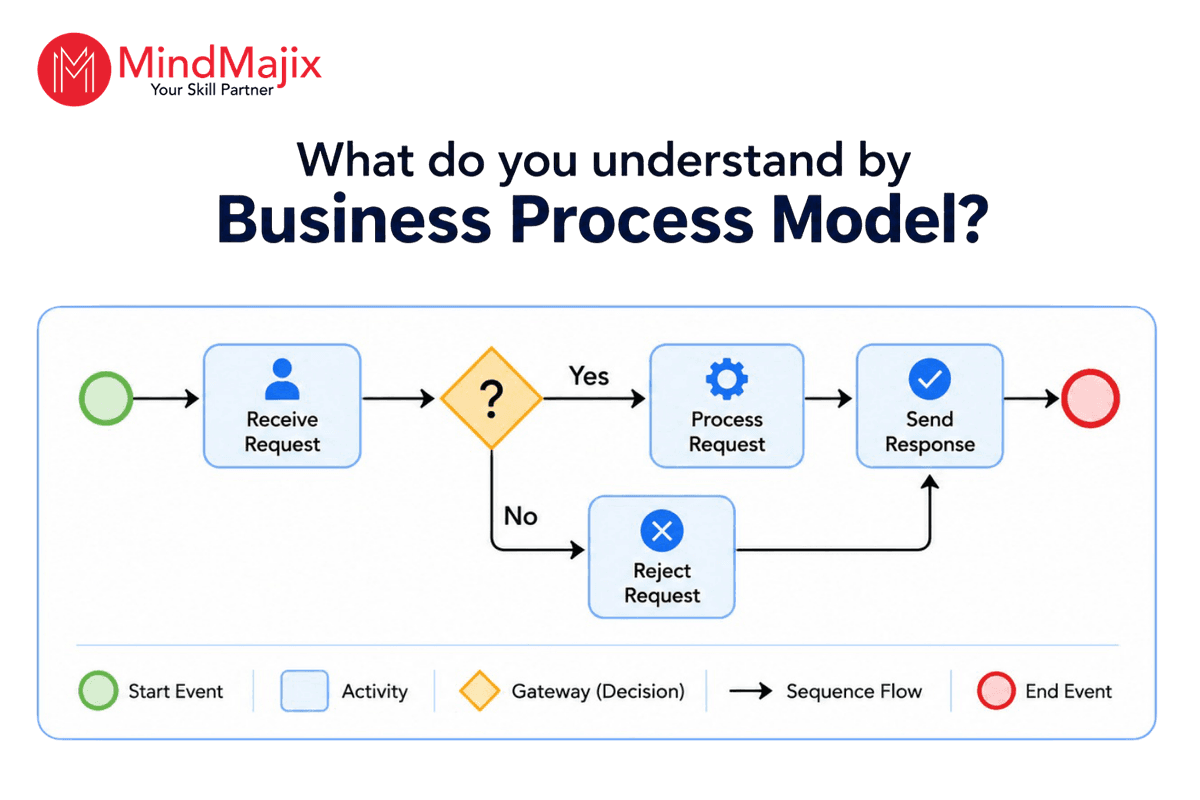
6: What do you understand by Business Process Model?
BPMN defines a Business Process Model as a network of graphical objects, which are activities, and the flow controls that define their order of performance.
7: What do you understand by Business Process Modeling Notation?
The Business Process Management Institute developed Business Process Modeling Notation to provide a process modeling language understood by all process modelers, users, analysts, etc.

8: What do you understand by connecting Objects?
Flow Objects are connected using connecting Objects. There are three types of connecting objects: sequence flow, message flow, and association.
9: Name any top competitor of the Appian BPM suite?
Pega Systems BPM Suite is a competitor to Appian.
10: Is BPM Appian an open-source application?
No. it is proprietary.
| Looking for Best Appian Online Training Platfrom in Hyderabad? To Enroll a Free Demo Click Here. |
11: What do you understand by Activities in BPM terms?
An activity is any work performed as part of a process. A rounded-cornered rectangle in a Business Process Model represents an activity.
There are two types of activities: tasks and sub-processes.
12: What do you understand by Annotations?
Annotations can be used to add textual comments within a process diagram.
13: What do you understand by Artifacts?
Artifacts allow process designers to extend the basic BPMN notation to include additional information in the process diagram. There are three types of artifacts: data objects, groups, and annotations.
14: What do you understand by Data Object?
Data Objects indicate that data is required or produced by activities in a process. Data Objects are represented in a Business Process Model by a picture of a piece of paper folded at the corner.
15: What do you understand by Events?
Events are anything that “happens” during a business process. Events can have a cause, referred to as a Trigger, and/or an impact referred to as a Result. Events are categorized based on where they occur in the process flow (start, middle, or end).
| → Explore Appian Sample Resumes Download & Edit, Get Noticed by Top Employers! |
Scenario-based Questions
1) How do you set up a data store object and a data type in Appian?
- Creating a data type: Below is the step-by-step procedure for creating a data type.
- Open Appian Designer
- Go to Build → New → Data Type
- Then choose ‘Create from scratch’ or generate from a database table.
- Add fields such as ID, name, email, and department.
- Select data types such as Integer, Text, Date, or Boolean.
- Save and publish the CDT.
- Creating a data store object: Below is the step-by-step procedure for creating a data store object.
- Go to build > new > data store object
- Select the already created CDT
- Select the existing database connection
- Configure the table name and schema name
- Map CDT fields to database columns
- Save and publish the object
2) Consider the scenario where you are unable to start a process model. How would you overcome this scenario?
- Cause of the problem: The required process information may be missing or invalid.
- Solution: You need to review all process information, including process properties, process variables, and default alerts, before starting the process model.
3) How can you set up security for a CDT in Appian?
In Appian, security settings cannot be set for a CDT. We need to manage it through related DSO and database permissions.
Below is the procedure for setting up security for a CDT object.
- Open the CDT object in Appian Designer
- Click Security
- Assign appropriate permissions to users or groups, such as viewer, editor, or administrator.
- Save the security settings
Frequently asked Questions
1) I am a beginner. Can I learn Appian easily?
Yes, you can learn Appian easily without a technical background. If you gain some knowledge about basic business processes, you can learn Appian quickly.
2) How long will it take to learn Appian?
You can learn Appian in 3 – 4 weeks. However, you must continue practicing your hands-on exercises after the training to become a skilled Appian developer.
3) Is there any Appian certification exam?
Yes, you can take the Appian Certified Associate Developer exam to demonstrate your expertise to employers.
4) Is Appian good to start a career?
Yes, you can learn Appian to start a career. Since it is a low-code business automation platform, you can apply for roles in business analysis, automation engineering, and development across industries.
5) Can I switch from manual testing to a career in Appian development?
It can be a strong career move to switch from manual testing to Appian development. That’s because Appian developers are in demand across companies. You can apply for many roles, including solution architect, process consultant, product owner, and more.
Conclusion
We hope these Appian interview questions have helped you understand the platform's features and functionality. Also, you have learned about the skills and job responsibilities of Appian developers, which will help you prepare for effective interviews.
If you want to learn more about Appian, you can enroll in MindMajix, where you can complete a course on Appian. By the end of the training, you will gain the competency to ace your Appian interviews.
 On-Job Support Service
Online Work Support for your on-job roles.

Our work-support plans provide precise options as per your project tasks. Whether you are a newbie or an experienced professional seeking assistance in completing project tasks, we are here with the following plans to meet your custom needs:
- Pay Per Hour
- Pay Per Week
- Monthly
| Name | Dates | |
|---|---|---|
| Appian Training | Oct 17 to Nov 01 | View Details |
| Appian Training | Oct 20 to Nov 04 | View Details |
| Appian Training | Oct 24 to Nov 08 | View Details |
| Appian Training | Oct 27 to Nov 11 | View Details |

Ravindra Savaram is a Technical Lead at Mindmajix.com. His passion lies in writing articles on the most popular IT platforms including Machine learning, DevOps, Data Science, Artificial Intelligence, RPA, Deep Learning, and so on. You can stay up to date on all these technologies by following him on LinkedIn and Twitter.


