- Blue Prism vs Selenium
- Career Scope in Selenium-The Future of Testing
- Essene of Getting Certified in Selenium
- Getting Started With Selenium
- Top 10 Reasons Why You Should Learn Selenium
- Selenium Interview Questions
- Selenium Release History Infographics
- Selenium Tutorial
- Tosca vs Selenium
- Automation Selenium RC using TestNG - Selenium
- Commands in Context Menu - Selenium
- Debugging - SELENIUM
- Different Flavours of Selenium
- Finding Elements by XPATH and Using CSS - SELENIUM
- How to Create test suites in Selenium
- How to Setup and Configure Selenium Webdriver with Eclipse
- How to use WebDriver Backed Selenium
- How to work on pages with AJAX in selenium?
- How to Install Debugbar Tool - SELENIUM
- How to Install IE Developer Tool - SELENIUM
- Installation of Selenium IDE
- Introduction to Selenium
- Introduction to Selenium 2.0 Webdriver-SELENIUM
- Java Tutorial for Selenium WebDriver
- How to Locate & Find Elements - SELENIUM
- Locators & How to Install Firebug - SELENIUM
- Running Test Cases - SELENIUM
- Sample Programs in Remote Control for Selenium
- Selenium Commands – “Selenese”
- Selenium Commands with Examples - SELENIUM
- Selenium WebDriver Commands List
- Synchronisation commands - SELENIUM
- What Is Selenium RC : A Step-by-Step Guide for 2024
- XPATH Usage in Selenium
- Skills That Will Make You a Champ Software Tester with Latest Trends
- Tricentis Tosca Automation Tool (2025)
- Tosca Interview Questions
- Using Selenium to Interact With Elements on a Web Page
- What is selenium IDE
- Xpath Interview Questions
- Selenium WebDriver Interview Questions
- Selenium With Python Interview Questions
- Selenium Projects and Use Cases
- Selenium Installation and Setup Guide
Software testing is essential for delivering reliable applications. Software must be tested thoroughly before it is delivered to users. Among many software testing tools on the market, Selenium is one of the most widely used web automation frameworks.
Selenium is an open-source automation testing tool used to run tests on web browsers. It helps developers and testers to simulate user interactions across multiple browsers and operating systems.
This article helps you understand Selenium in-depth and its latest features. Let’s dive in!
Table of Contents
- Types of Software Testing
- Selenium – An Introduction
- Why Selenium?
- Selenium 4 – A Deep Dive
- Comparison between Selenium 4 and Selenium 3
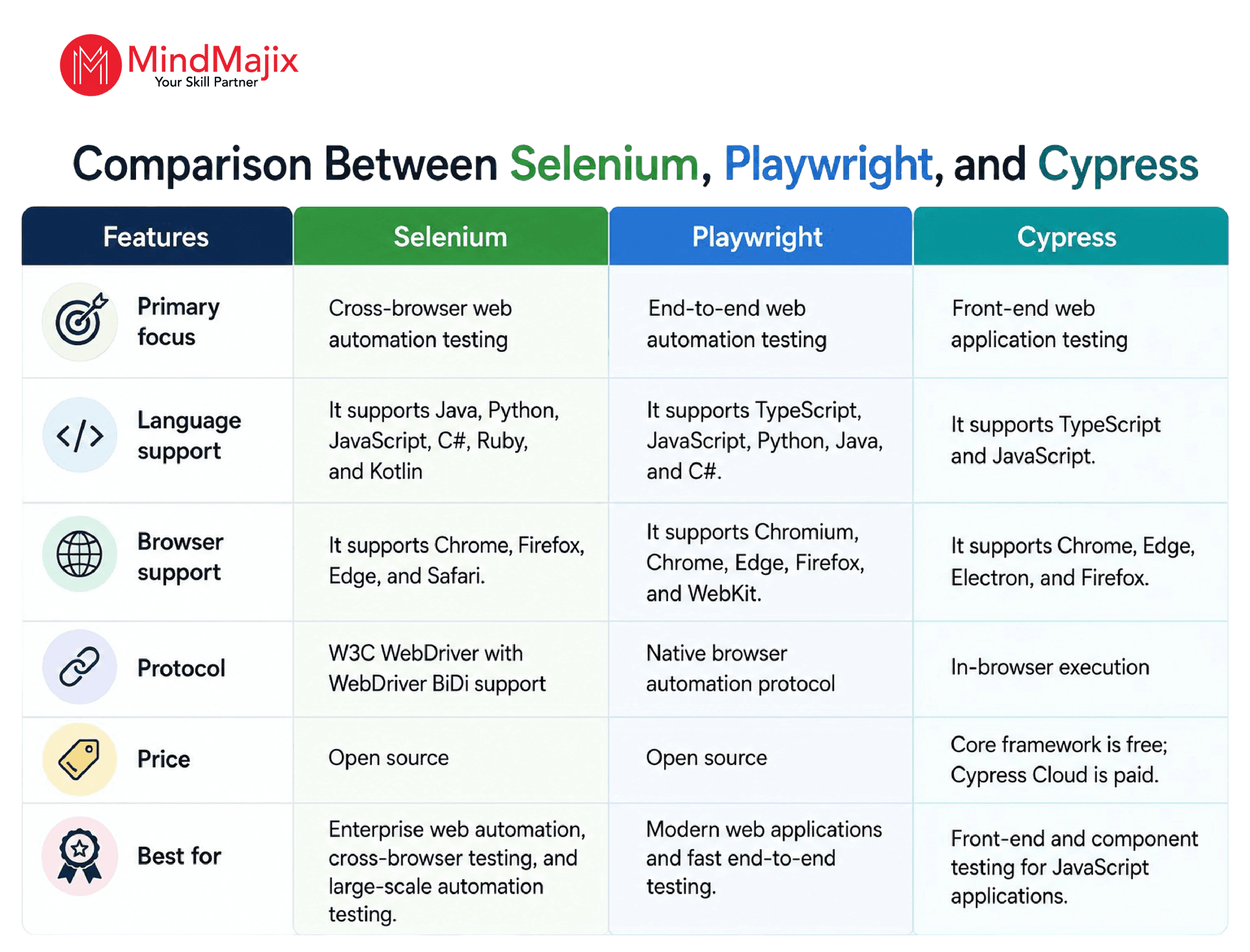
- Comparison Between Selenium, Playwright, and Cypress
- Advantages and disadvantages of Selenium
- Frequently Asked Questions
Types of Software Testing
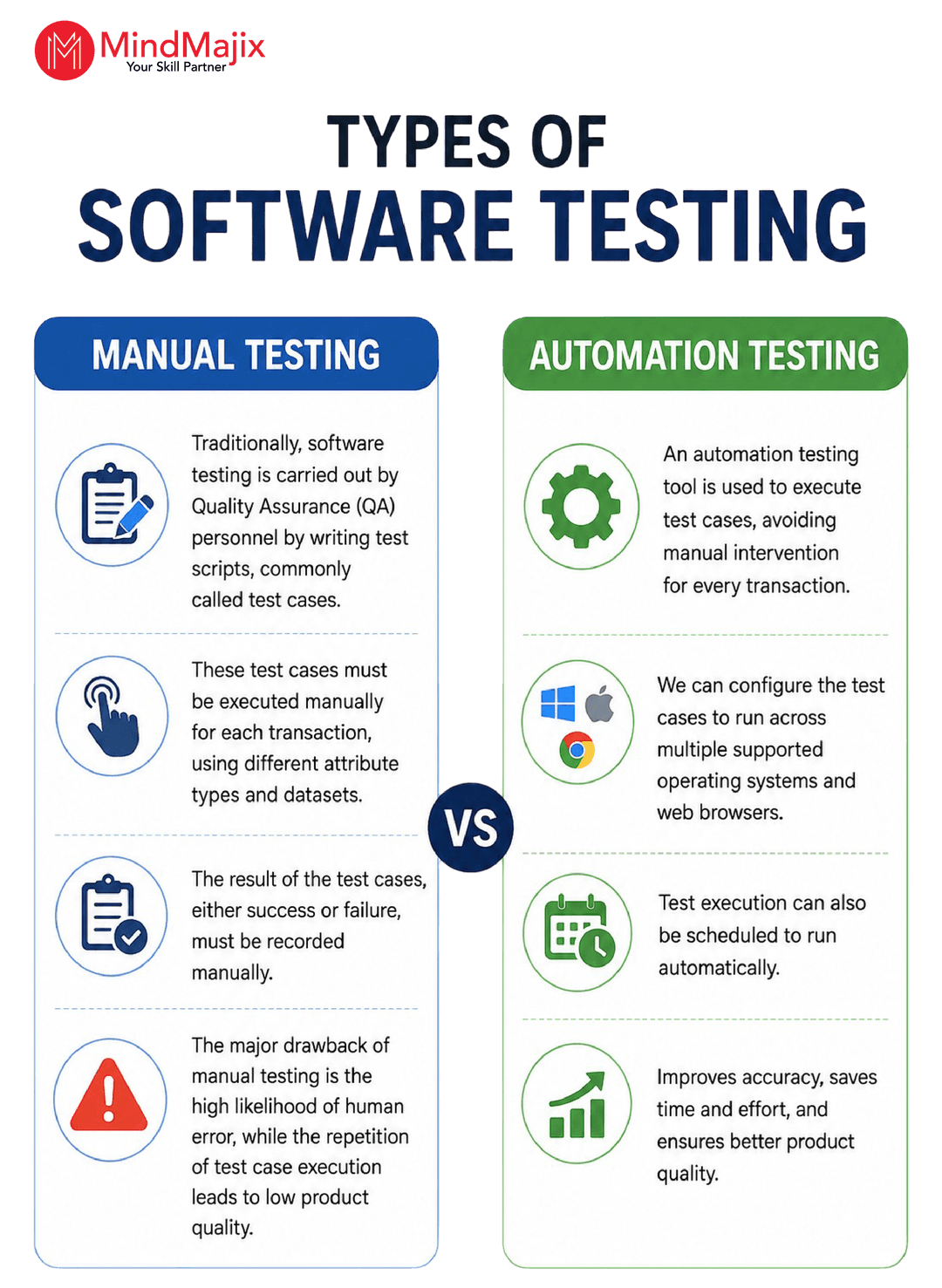
There are two types of software testing: manual and automated. The image below clearly depicts the differences between the two.
Selenium – An Introduction:
The first Selenium testing tool was developed by Jason Huggins in the year 2004. As part of his work testing web applications, Jason realised that manual testing had become less efficient due to repeated test cases.
This led to the creation of a JavaScript program called “JavaScriptTestRunner” to automatically control browser actions. Recognising the potential in his idea, Jason made the JavaScript program open source and renamed it Selenium Core.
- Selenium Market Share:
Selenium holds approximately 22.84% market share among web automation tools, according to 6sense. Additionally, more than 48,000 companies use Selenium worldwide.
Since its initial release in 2004, Selenium has evolved into one of the world’s largest open-source browser automation ecosystems. Selenium skills are a must for many job roles, including Java, Python, and C#.

Why Selenium?
In addition to Selenium, there are many automation testing tools, such as Playwright, Cypress, Appium, Katalon, TestComplete, TestPlant, Tricentis, Ranorex, and Robot Framework. These include both commercial and open-source automation testing frameworks.
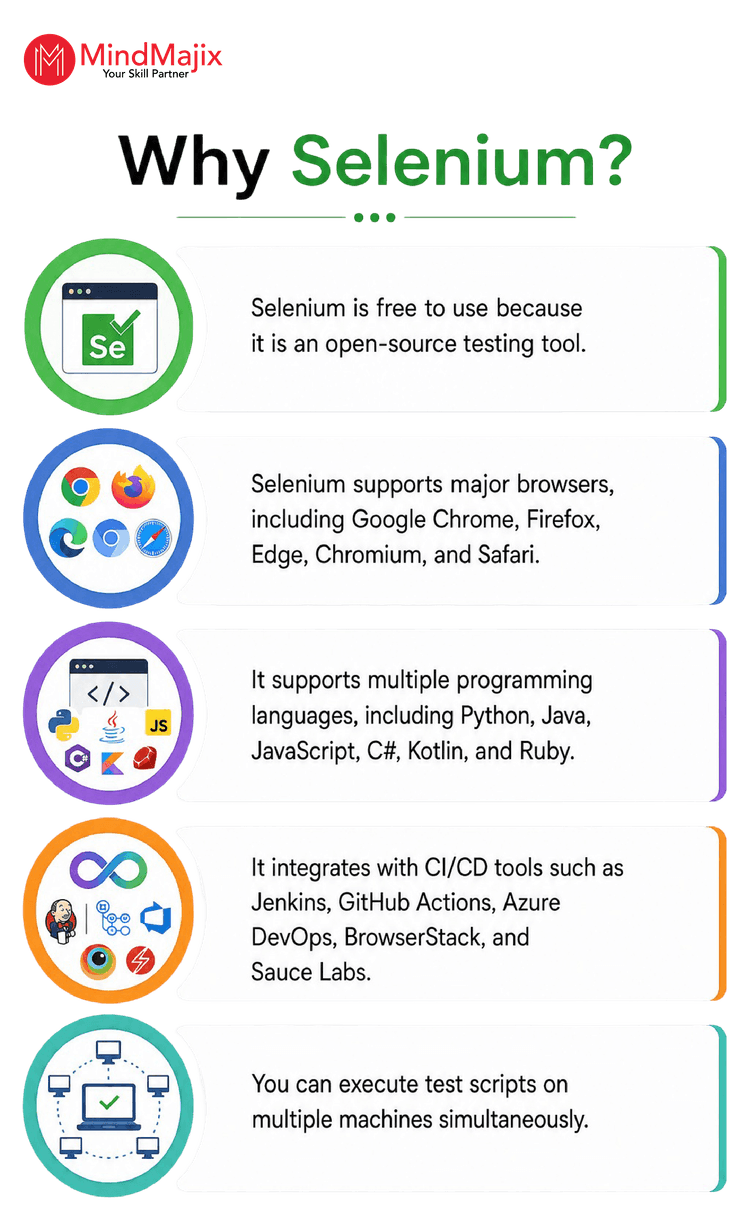
However, Selenium plays a pivotal role in automation testing. Here are the key reasons:
Selenium 4 - A Deep Dive
Selenium 4 is the latest version of Selenium, offering enhanced browser automation capabilities and greater compliance with standards.
Let’s walk through the key capabilities of Selenium 4.
- W3C WebDriver Standard:
Selenium WebDriver was created by Simon Stewart in 2006 as the replacement for Selenium RC. Selenium WebDriver provides an interface for creating and executing test cases. You can design the test cases to identify web page elements and perform necessary actions.
WebDriver is much faster than RC because it directly calls the browser. In contrast, RC needs a server to interact with the browser and depends on JavaScript for automated web application testing.
Let’s learn more about the W3C WebDriver standard.
-
- Each web browser has its own WebDriver, such as ChromeDriver, GeckoDriver (Firefox), EdgeDriver, and SafariDriver.
- Selenium WebDriver supports languages including C#, Java, JavaScript, Python, and Ruby.
- It replaces the older JSON Wire Protocol and offers improved cross-browser compatibility, browser behaviour, stability and reliability, handling of dynamic pages, and more.

- Selenium Manager:
Selenium Manager automatically finds, downloads, caches, and manages browser drivers. It removes the need for manual installation of ChromeDriver, GeckoDriver, or EdgeDriver in most situations. It can also handle browser binaries, eliminating the need for manual driver management in most environments.
By using the Selenium Manager, you can:
-
- Enable automatic driver management for Chrome, Firefox, Edge, and other supported browsers.
- Automate browser discovery on local machines.
- Perform driver version matching with the installed browser.
- Enable local caching to avoid repeated downloads.
- Relative Locators:
Selenium 4 introduced Relative Locators, which make it easier to locate elements by position. The supported locators include above(), below(), toLeftOf(), toRightOf(), and near().
- WebDriver BiDi Support:
Selenium 4 supports WebDriver BiDi—a bidirectional WebSocket communication protocol. It allows two-way communication between the browser and automation code.
WebDriver BiDi is the next-generation W3C standard for browser automation. It supports real-time event streaming, allowing Selenium to listen for browser events, capture network traffic, read console logs, and more.
The capabilities of WebDriver BiDi include:
-
- Supports real-time browser events
- Monitors HTTP requests and responses
- Gathers browser console output without browser-specific APIs
- Detects page loads, navigation, and window changes
Note that Vibium is an AI-native browser automation framework built on the WebDriver BiDi standard. Both testers and AI agents can use this framework for automating browser interactions.
The good thing about Vibium is that it requires minimal setup and downloads, and it automatically manages Chrome for testing.
Related Article: Selenium Tutorial for Beginners
- Selenium IDE 4.5 (Manifest V3)
Selenium Integrated Development Environment (IDE) is one of the key components in the Selenium automation testing suite. IDE is available as a Chrome browser extension that can be easily installed to record and execute frequent test cases quickly.
By using Selenium IDE, you can record user interactions in the web browser and create test cases from the recordings. You can play back these test cases whenever you need. Importantly, Selenium IDE is suitable for quick prototyping and simple regression tests but is not intended for complex automation frameworks.
Selenium IDE 4.5 is a significant update that modernises the Selenium IDE browser extension by moving it to Chrome Manifest V3 (MV3). Manifest V3 (MV3) is the newest browser extension platform introduced by Google Chrome to improve security, privacy, performance, and resource efficiency.
The capabilities of Selenium IDE 4.5 include:
-
- Support for the Manifest V3 architecture
- Replacement of background pages with service workers
- Validation of multiple locator strategies, including CSS selectors, XPath, and text-based locators.
- Enhanced test runner UI for clear execution feedback and easy test management.
- Enables quick test prototyping to create a POC without writing code
- Support for regression test recording
- Selenium Grid
Selenium Grid is a Selenium testing tool for executing test cases remotely. Patrick Lightbody created it to minimise test case execution times. Selenium Grid was initially named Hosted QA and was a part of Selenium 1.
Selenium Grid 4 uses a distributed architecture to support the parallel execution of multiple test cases across multiple remote machines.
Now we conclude the overview of Selenium’s core components and jump into a comparison between Selenium 4 and Selenium 3.
Comparison between Selenium 4 and Selenium 3
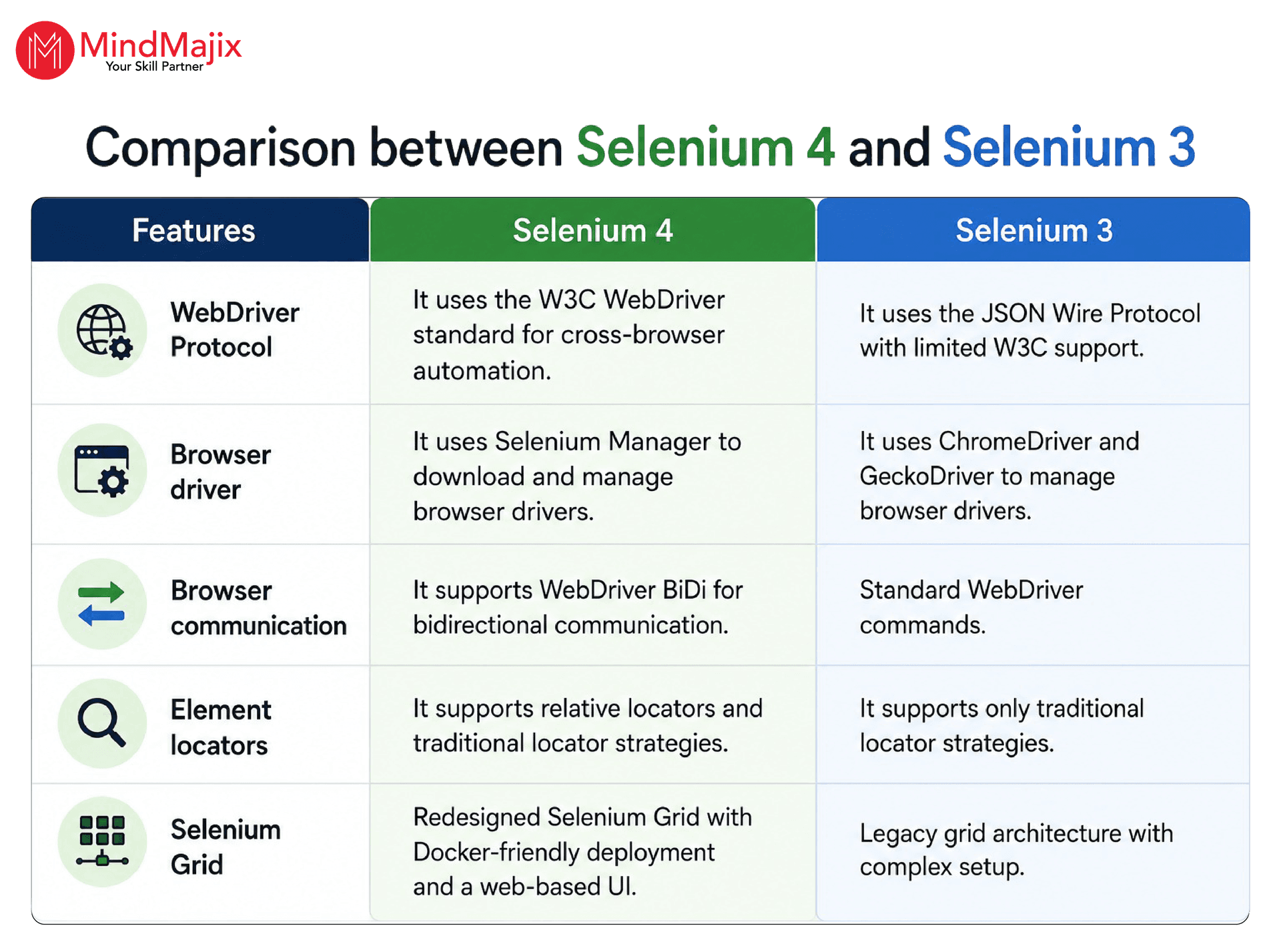
We all know that Selenium 4 is an enhancement of Selenium 3. The table below compares the two based on multiple factors.
Comparison Between Selenium, Playwright, and Cypress
Let’s compare Selenium with other automation testing tools like Playwright and Cypress in the table below.
Advantages and Disadvantages of Selenium
Advantages of Selenium:
Let’s list the advantages of the Selenium testing tool.
- Selenium is an open-source automated testing tool and free to use.
- It provides testers with greater flexibility to write advanced, complex test cases.
- It supports test scripts written in official language bindings such as C#, Java, Python, JavaScript, Kotlin, and Ruby.
- It supports test case execution across multiple operating systems, including Windows, Linux, and more.
- It supports testing on different web browsers such as Chrome and Safari.
- It provides headless mode support for many browsers.
- It supports parallel test execution.
- It can be integrated with TestNG and JUnit to generate test reports and manage test cases.
- It can be integrated with Jenkins, Maven, and Gradle.
Disadvantages of Selenium
Selenium testing tool has some shortcomings, including:
- Selenium is primarily used for testing browser-based applications.
- No guaranteed user support is available. You must depend on community support.
- Selenium doesn’t natively support visual/image testing. It must be integrated with Applitools Eyes, Percy, Argos, or Visual Regression Tracker.
Related Article: Selenium Interview Questions and Answers
Frequently Asked Questions
1) What is the current version of Selenium?
Ans: As of August 2026, the latest stable version of Selenium is 4.46.0. It was released on July 11, 2026. This version is available for Java, Python, JavaScript, C#, Ruby, and the Selenium Grid server.
2) Is Selenium still relevant in 2026?
Ans: Yes, Selenium remains highly relevant in 2026. Here are the reasons:
- Many large organisations have invested heavily in Selenium-based automation frameworks.
- Selenium continues to provide strong support for Google Chrome, Mozilla Firefox, Microsoft Edge, and Safari.
- Unlike some newer tools, Selenium supports several programming languages, including Java, C#, JavaScript, and Ruby.
- Selenium also integrates well with modern DevOps tools such as Jenkins, GitHub Actions, Azure DevOps, and GitLab CI/CD.
3) Selenium vs Playwright — Which is better?
Ans: Both tools excel in automation testing, so there is no single winner. Choosing the right tool depends on your project requirements.
Choose Selenium if you want to use:
- Cross-browser testing across a wide range of environments.
- Java or Python and need compatibility with existing tools.
Choose Playwright if you want to:
- Perform modern web automation
- Develop modern automation faster.
- Use built-in auto-waiting, screenshots, videos, tracing, and network interception
4) Is Selenium free?
Ans: Yes, Selenium is an open-source tool. Not only that, the Selenium ecosystem, including Selenium WebDriver, Selenium IDE, Selenium Grid, and Selenium Manager, is also free.
5) Should I learn Selenium or Playwright in 2026?
Ans: Choose Selenium if you:
- Work mostly with Java or C#
- Want to automate mobile testing using Appium
Choose Playwright if you:
- Work on a new project
- Use JavaScript or TypeScript as a primary language
- Need faster test development and execution
6) What languages does Selenium support?
Ans: Selenium supports popular programming languages including Java, Python, JavaScript, Ruby, and C#.
Conclusion
In short, Selenium helps developers and testers test enterprise web applications automatically. It supports multiple browsers, operating systems, and programming languages.
If you want to learn more about Selenium, you can sign up for the Selenium course with MindMajix. The training provides you with hands-on skills to develop Selenium automation and skyrocket your career.
 On-Job Support Service
Online Work Support for your on-job roles.

Our work-support plans provide precise options as per your project tasks. Whether you are a newbie or an experienced professional seeking assistance in completing project tasks, we are here with the following plans to meet your custom needs:
- Pay Per Hour
- Pay Per Week
- Monthly
| Name | Dates | |
|---|---|---|
| Selenium Training | Oct 27 to Nov 11 | View Details |
| Selenium Training | Oct 31 to Nov 15 | View Details |
| Selenium Training | Nov 03 to Nov 18 | View Details |
| Selenium Training | Nov 07 to Nov 22 | View Details |

Madhuri is a Senior Content Creator at MindMajix. She has written about a range of different topics on various technologies, which include, Splunk, Tensorflow, Selenium, and CEH. She spends most of her time researching on technology, and startups. Connect with her via LinkedIn and Twitter .